



We’re here to help
Let us help you
Melt flow index testing is essential to the plastics industry for the flow analysis of polymers and thermoplastics. From the basic, budget-friendly ART-MFi10 MFI to the advanced testing capabilities of the ART-MFi30 Advanced MFI, we have Melt Flow Indexers capable of accurately determining results for Melt Flow Rate (MFR), Melt Volume Rate (MVR), density at test temperature, shear stress, shear rate, viscosity, and IV.
Often used to test batch-to-batch consistency in manufacturing processes such as extrusion and injection moulding, we’ll help you choose the best MFI tester for your application, so you meet ASTM D1238 and ISO 1133 standards.
MFI equipment need calibrating? We can help with that too, ensuring long-term reliability and performance of your test instrument, so you benefit from accurate and repeatable results.
Showing all 10 results
Filter
An MFI is a laboratory device used to measure the flowability of polymer melts at controlled temperature and pressure conditions. It can be entirely electronic, pneumatic, or a combination of the two, providing invaluable data to manufacturers, so they’re confident their raw materials meet quality control requirements.
This is a measure that tells you how easily a thermoplastic polymer flows through a standardised die when melted, while subjected to a specific load and temperature.
The MFI will go up or down depending on the material’s viscosity and is indicative of a change in the polymer. Think of viscosity as the resistance to the flow.
The lower the viscosity of the melted thermoplastic polymer, the easier the flow and the quicker the movement, meaning the MFI rises. On the other hand, the MFI will go down when there’s more viscosity.
The following formula is used to calculate the MFI of polymers:
Flow rate = (600/t X weight of extrudate of polymers)
t = time taken to collect the extrudate in seconds
melt flow rate = g/10 min.
Melt flow index apparatus are vital for the plastics, aerospace, automotive, packaging, and medical industries. Common applications include:
AML’s MFIs have standard features like automatic calculation of results and robust construction for long-term industrial use.
However, it’s our Artemis Instruments MFIs that are known for their state-of-the-art technology and unmatched accuracy (+/-0.1 °C) and reliability. These models cater to various testing needs, from simple to complex, ensuring a solution for every level of requirement. Some of their key benefits include:
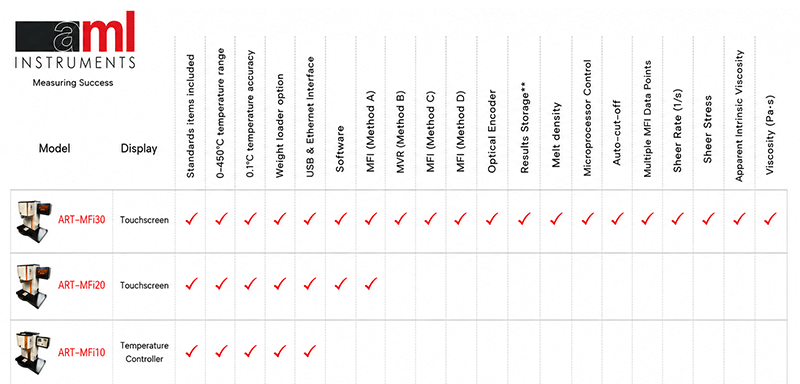
Our MFIs are designed for ease of use, from setup to result interpretation:
Of course, if you and your workforce need any training with your new testing equipment, our expert team will be happy to assist.
All our MFI models comply with ASTM D1238 (Test Method A, B, C, or D) and ISO 11133-1 standards. For reference, Methods A, B, and C relate to specific ASTM D1238 test methods designed to determine the flow rates of thermoplastics.
As our MFIs have different automation, features, technical specifications, and testing capabilities, meaning the cost will vary significantly from basic models to more sophisticated MFI testers. To help us find you the best instrument for your application at the right price, we need to know:
Choosing an MFI from AML Instruments means more than acquiring high-performance equipment, meeting rigorous accreditation standards, and enabling you to effectively conduct melt flow tests on your materials.
It’s about securing a commitment to excellence that spans the entire lifespan of your instrument. Our comprehensive support surpasses standard service, offering calibration, maintenance, and expert guidance to ensure your operations continually achieve peak performance and accurate products are delivered to your customers.
Prepped to purchase precision?
☎️ 01522 789375
Let us help you