



We’re here to help
Let us help you
Poorly tested packaging has ruined many a Christmas. However, for any business involved in shipping and receiving packages, the damage goes beyond the spoilt surprises.
Incorporating robust packaging testing methods into your quality control processes will help you validate whether your packaging can survive in real-world shipping conditions. It's a core part of delivering quality and aligning with packaging testing standards to ensure product integrity and safety during transportation.
Read on as we unpack key packaging testing practices and insights, from the many package testing methods to tips on choosing the right packaging test equipment for your testing needs.
Package testing determines whether your packaging designs and materials can withstand their shipping journey during handling, transportation, and storage, so the contents undamaged.
It’s a vital process for quality assurance engineers, packaging technologists, and product manufacturers, enabling them to quickly and accurately identify strengths and weaknesses in their packaging materials.
If your packaging fails, you can put your entire product lifecycle in jeopardy. Comprehensive packaging performance testing ensures your packaging performs consistently across diverse conditions and environments, so the contents arrive without damage or signs of contamination or degradation between the packaging materials and packaged product(s).
Of course, the downsides of a damaged product as a result of faulty packaging isn’t just financial. You may also have to deal with:
If producing robust and shipping-resilient packaging is essential to your operations, regular package material testing should be part of your quality assurance strategy. Comprehensive inspections a couple of times a year will ensure your packaging passes integrity tests and can endure impacts, vibrations, climatic conditions, and other stresses experienced during shipping.
Testing of packaging materials should also be carried out before large product shipments, when changing materials or suppliers, and after any quality issues/packaging defects.

Bulk pallets of packaging boxes being loaded onto a container truck.
Developing a systematic packaging testing protocol helps businesses in industries like electronics, food, and pharmaceuticals drive compliance, repeatability, safety, sustainability, and continuous improvement.
We’ve outlined some of the most important steps below to help you achieve optimal results.
What you’re ultimately setting out to do is determine whether your chosen packaging materials are suitable for their intended purpose. Identify what you’re tying to achieve. Is it to check the packaging’s resistance to moisture? Maybe you need peace of mind the closures are leak-proof, or perhaps you’re interested in its eco-friendly performance?
Taking into consideration the environments your packaging will encounter (retail, cold chain, etc.) can also help shape your objectives and choose the best packaging test equipment and method for the job.
Now you’ve established your objectives, it’s time to decide on the testing methods you’re going to use for your packaging materials.
We’ve outlined some of the most common packaging tests below, covering both primary packaging and secondary packaging testing methods. Primary packaging is the first layer that contains the product itself, while the secondary packaging surrounds it, providing an additional layer of protection during transportation and storage.
Barrier property testing – Used to evaluate packaging’s resistance to air, gas, and moisture, which could negatively impact product quality or shelf life.
BCT (Box Compression Testing) – This is the testing of the completed box or package with or without the product inside.
Burst testing – Measures the burst resistance of the packaging material, widely used in paper and board applications
Compatibility testing – Crucial in industries like chemicals and cosmetics to stop the product from chemically or physically interacting with the packaging over time.
Compression testing – Determines how the sample material or finished packaging behaves when it’s crushed or compressed.
Drop and impact testing – Commonly used for hazardous product packaging to test the robustness and protective qualities of packaging materials should a packaged item be dropped.
Dynamic Stiffness Testing (DST) – Measures the MD torsional stiffness of corrugated board by a natural oscillation technique patented by Korutest in 2005. Using this method the board is subjected to a displacement and allowed to oscillate freely.
Environmental testing – Looks at packaging performance under different storage and shipping conditions such as temperature and humidity variations.
Seal integrity testing – Tests the tightness of the packaging’s sealed seams, so it’s free from any defects that could cause leaks. For more information, see our Adhesives and Adhesive Tapes Testing Guide.
Short Span Compression Testing (SCT) – Used to measure the compressive strength of paper and cardboard samples. This method evaluates how stiff the corrugating paper is and is a good indicator of finished board strength.
S-Test – Designed as an alternative to the more traditional CMT test, this is a relatively new method for measuring the compressive strength of medium paper.
Vibration testing – Think of a package constantly juddering in a truck. Package vibration testing checks if it will hold up to consistent vibrations during transit.
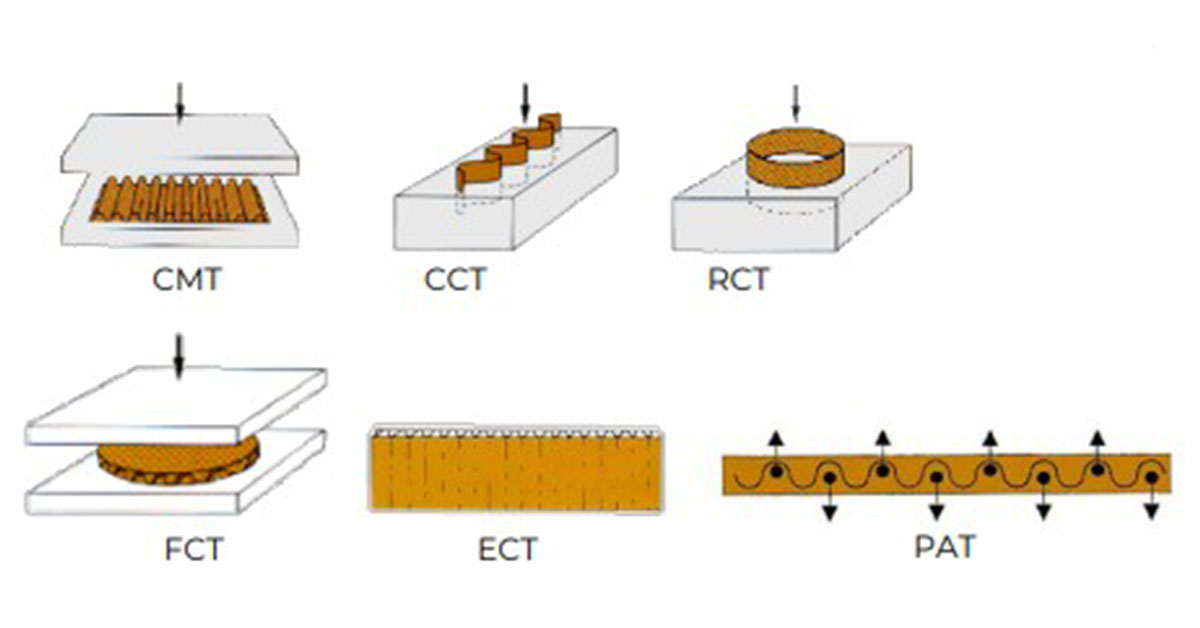
Different corrugated board testing methods applied to a specimen, labelled as CMT, CCT, RCT, FCT, ECT, and PAT.
AML’s application engineers are on hand to help you determine the correct methods and equipment for your particular packaging and materials. Contact us today for free advice at [email protected] or call 01522 789375.
To guarantee accurate, repeatable results and quality packaging, you must choose the correct packaging test instrument and ensure it’s kept up to date with calibration. While factors like packaging volume and budget constraints will come into play, also think about the machine’s compliance with applicable testing standards.
Common testing equipment used in the packaging industry includes:
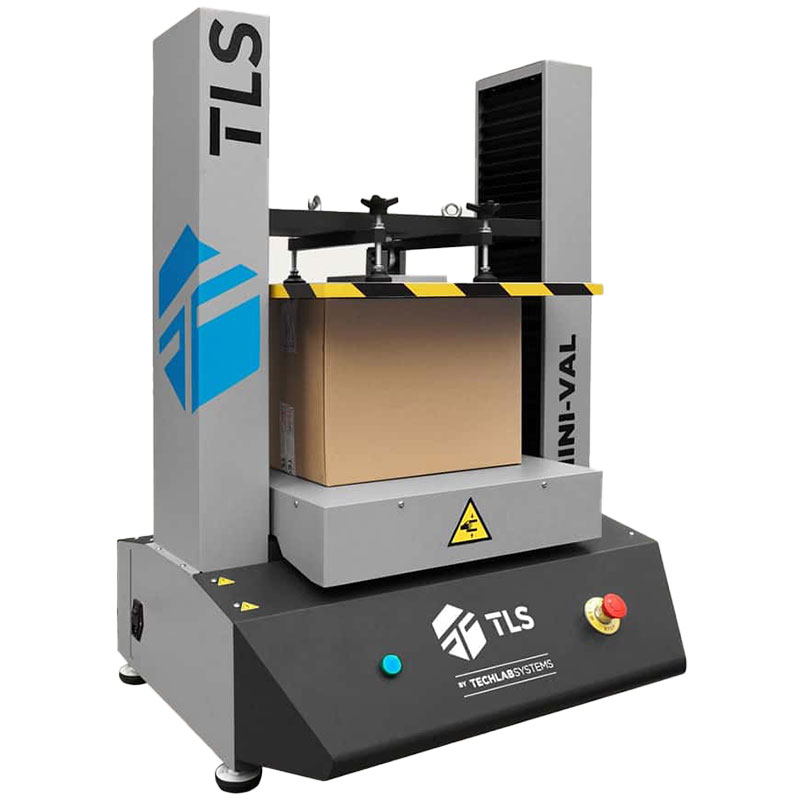
Compression tester applying force to a cardboard shipping box.
Now’s time to get testing. Goods travel worldwide everyday, so base your simulations on seasonal variables and actual shipping routes to obtain reliable data. Combining tests such as compression and vibration is also effective for uncovering compound weaknesses in your packaging.
Careful analysing your packaging test results will enable you to assess its functionality, integrity, and suitability for the intended product. Use your findings to modify designs and refine materials to eliminate any potential fragile points.
Package testing should always be a rotating wheel of product development, so a regular, testing schedule and maintaining detailed testing parameters and records will drive improvement in your packaging material quality and efficiency.
Demonstrating alignment with rigorous standards demonstrates your commitment to providing packaging that’s consistent, compliant, and sufficiently robust to ensure the integrity and safety of its products.
Several regulatory bodies define packaging testing standards, including the American Society for Testing (ASTM), the International Safe Transit Association (ISTA) for transit challenges, and the International Organisation for Standardisation (ISO) for global consistency. The latter is especially critical in international markets and when shipping delicate items like medical devices.
Here’s a further breakdown of some specific packaging test standards.
| Test Standard | Description |
| ASTM D5276 | Industry standard for assessing the impact resistance of a container by the free-fall (drop) method. |
| ASTM D642 | Evaluates the compressive strength of packaging systems. |
| ASTM D999 | Evaluates the packaging’s ability to protect the inner contents against vibration stresses. |
| ASTM F2825 | Used to gauge the ability of packaging systems to withstand various climatic stresses that occur in actual distribution. |
| ASTM D3078 | Leak testing of flexible packaging (Bubble Emission Method). |
| ASTM D7030 | Constant compression load resistance of corrugated containers. |
| ASTM F88 | Seal strength testing of flexible pouches and barrier materials. |
| ASTM F1929 | Detecting seal leaks in medical packaging. |
| TAPPI T804 | Compression test of fibreboard shipping containers. |
| TAPPI T807 | Bursting strength of paperboard & linerboard. |
| TAPPI T810 | Bursting strength of corrugated & solid fibreboard. |
| TAPPI T811 | Edge Compression Test (Corrugated). |
| ISO 12048 | Compression and stacking tests using a compression tester. |
| ISO 11607-1-2 | Used in the medical packaging industry for validating the packaging of terminally sterilised medical devices. |
ISTA
ISTA standards are organised into series covering screening, partial simulation, general simulation, enhanced, member-specific, and development testing.
| STA Series | Procedures | Description |
| Series 1 | 1A, 1B, 1C, 1D, 1E, 1G, 1H | Non‑simulation integrity tests for basic packaging robustness |
| Series 2 | 2A, 2B, 2C | Partial simulation tests for refining packaging design |
| Series 3 | 3A, 3B, 3E, 3F, 3H, 3K, 3L | General simulation tests modelling full transport hazards |
| Series 4 | 4AB | Enhanced simulation for user‑defined distribution environments |
| Series 6 | 6‑Amazon, 6‑FedEx A/B, 6‑SamsClub | Retailer and carrier specific compliance standards |
| Series 7 | 7D, 7E | Development tests including thermal and environmental |
Packaging testing plays a pivotal role in ensuring your products can withstand their journey and arrive without damage as often as possible. We’ve been supplying, calibrating, and repairing packaging test instruments for over 40 years, with full operator training and technical support included.
Along with our standard packaging test equipment range, we’re happy to work with you to build a customised machine that supports your unique packaging requirements and product profiles.
Our team is here to help you navigate the complexities of packaging testing and ensure your packaging is compliant with industry and customer-specific standards. Get in touch to speak with a packaging expert today!
Let us help you