
Power Supply Calibration
Power supplies are the driving force behind all electronic devices. From audio systems to computers, industrial machines, medical devices, and telecommunication equipment, they supply and modify the output of electrical energy to power one or more electrical loads.
But these devices won’t function accurately and reliably if your power supply isn’t delivering the correct voltage at a rated current/power suited for your products or application.
Power supply calibration removes the guesswork, helping ensure precise and stable power sources that are foundational to safe and efficient electrical operations.
AML Instruments offer traceable onsite and offsite electrical calibration services for all types of power supplies and other electrical testing tools. Read on to discover the type of power supplies we can calibrate and how our expert team can perfect your power supplies to ensure the longevity and optimal performance of your electronic devices.
Industries we support


Types of power supplies we calibrate
- AC/DC and DC/DC converters.
- Battery chargers.
- Linear power supplies.
- Switched-Mode Power Supplies (SMPS).
- Uninterruptible Power Supplies (UPS).
Onsite power supply calibration
Guaranteeing minimal disruption and operational downtime, our onsite calibration service is where one (or more) of our engineers come to your facility to calibrate your power supplies.
Just give us a call or email, and we’ll sort out a mutually-convenient date and time to not just get the job done, but get it done well.
Offsite power supply calibration
If you can afford to be without your power supplies for a little while (or have backup), sending them to our calibration lab in Lincolnshire is usually the most cost-effective option.
Once we’ve received your electrical equipment, our engineers will add it to their workload, and we’ll then safely ship it back to you within five working days (tracking details will be provided).
Express 24-48 hour services are also available (pre-booking required). Depending on engineer availability, there’s also the option to bring your equipment to us and relax while we calibrate it there and then. Again, we would need advanced notice, so we can check we have the necessary resources.
Local calibration collection and delivery service
Offering precision from pickup to dropoff, we also offer a local calibration collection and delivery service for businesses within a 40-mile radius of our lab (postcode LN1 2WE).
How much does it cost to have a power supply calibrated?
Power supplies up to 10amp cost £40. For supplies with higher power outputs, please contact us for a quote.
Keep your power supplies within their parameters
By establishing a regular power supply calibration schedule with a trusted calibration specialist like AML, you can be confident in maintaining accurate measurements and the seamless operation of your everyday devices and critical communication and industrial systems.
Get in touch to book your calibration slot or alternatively send your power supplies our way.
☎️ 01522 789375
Why is calibrating your power supply important?
Like all electrical testing equipment, power supplies drift over time. This can be through component ageing, environmental factors, or voltage shifts.
Calibration is the process used to correct these errors, where the measuring instrument is compared to an accurate reference to verify it’s operating within the manufacturer’s specifications. It plays a fundamental role in ensuring operator safety, maintaining power supply accuracy, and complying with national or international stands (depending on the level of traceability you require).
How often should you get your power supplies calibrated?
Allowing a year between calibrations is usually the sweet spot when it comes to keeping your power supplies on point. However, for industries carrying out critical measurements and requiring strict traceability (aerospace, medical devices, etc.), the frequency is usually upped to every three or six months.
Factors like wear and tear can also mean you need to calibrate more often.
How to calibrate a power supply
Power supplies handle dangerous internal voltages and amps that can cause severe shock or damage equipment if mishandled. While the basic steps below seem simple, achieving true accuracy is highly complex. A small error can ruin sensitive electronic components or lead to unsafe workplace conditions.
Professional labs like AML Instruments use specialised equipment (high precision multimeters), control for environmental variables, and provide official certificates of calibration for your quality assurance records.
Important: To guarantee compliance with international standards (such as UKAS, ISO/IEC 17025, etc.) and ensure the highest level of precision, you should always use a certified, professional calibration provider.
- Disconnect and Isolate: Turn off the power supply, disconnect all loads, and test pieces.
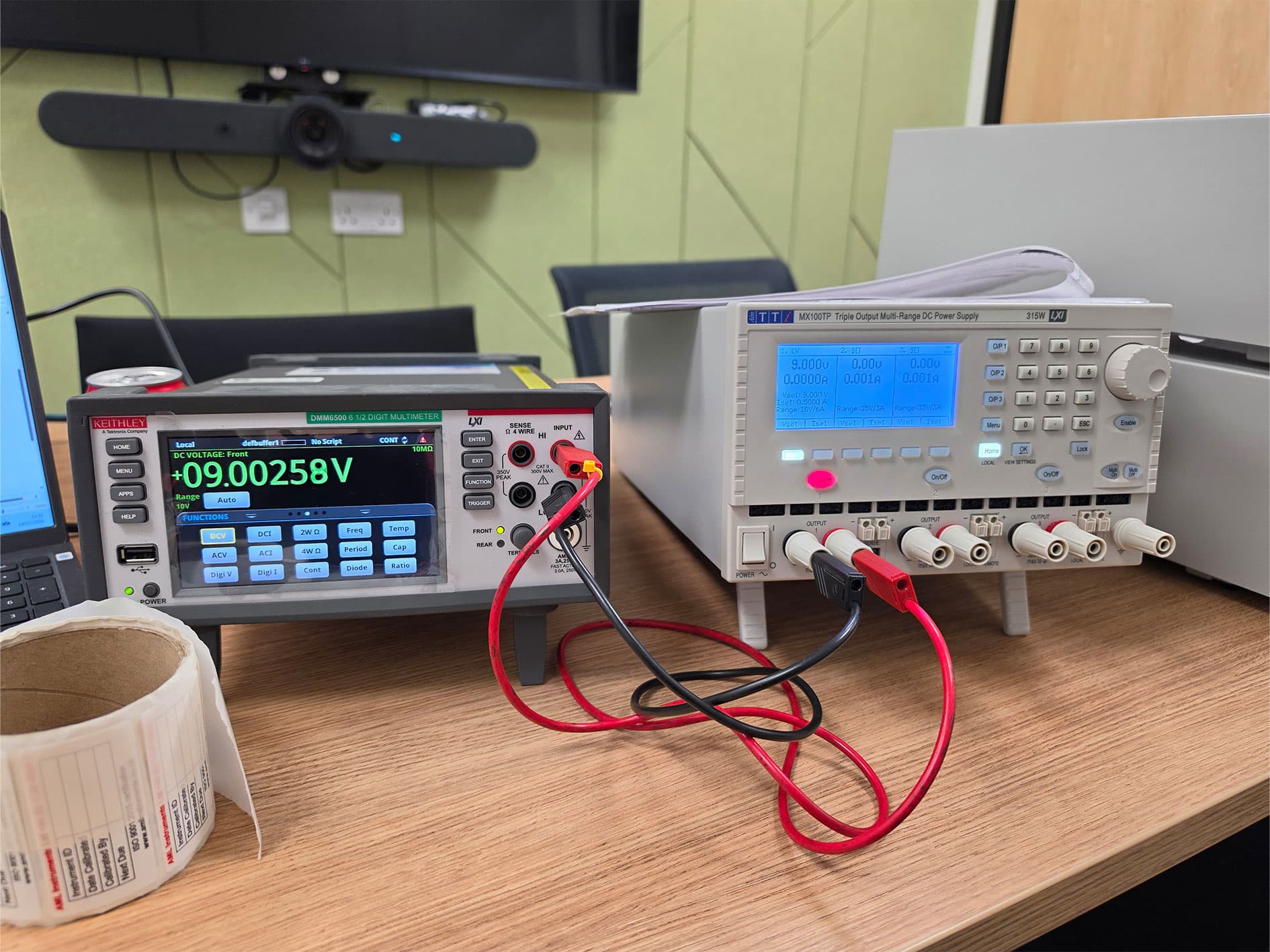
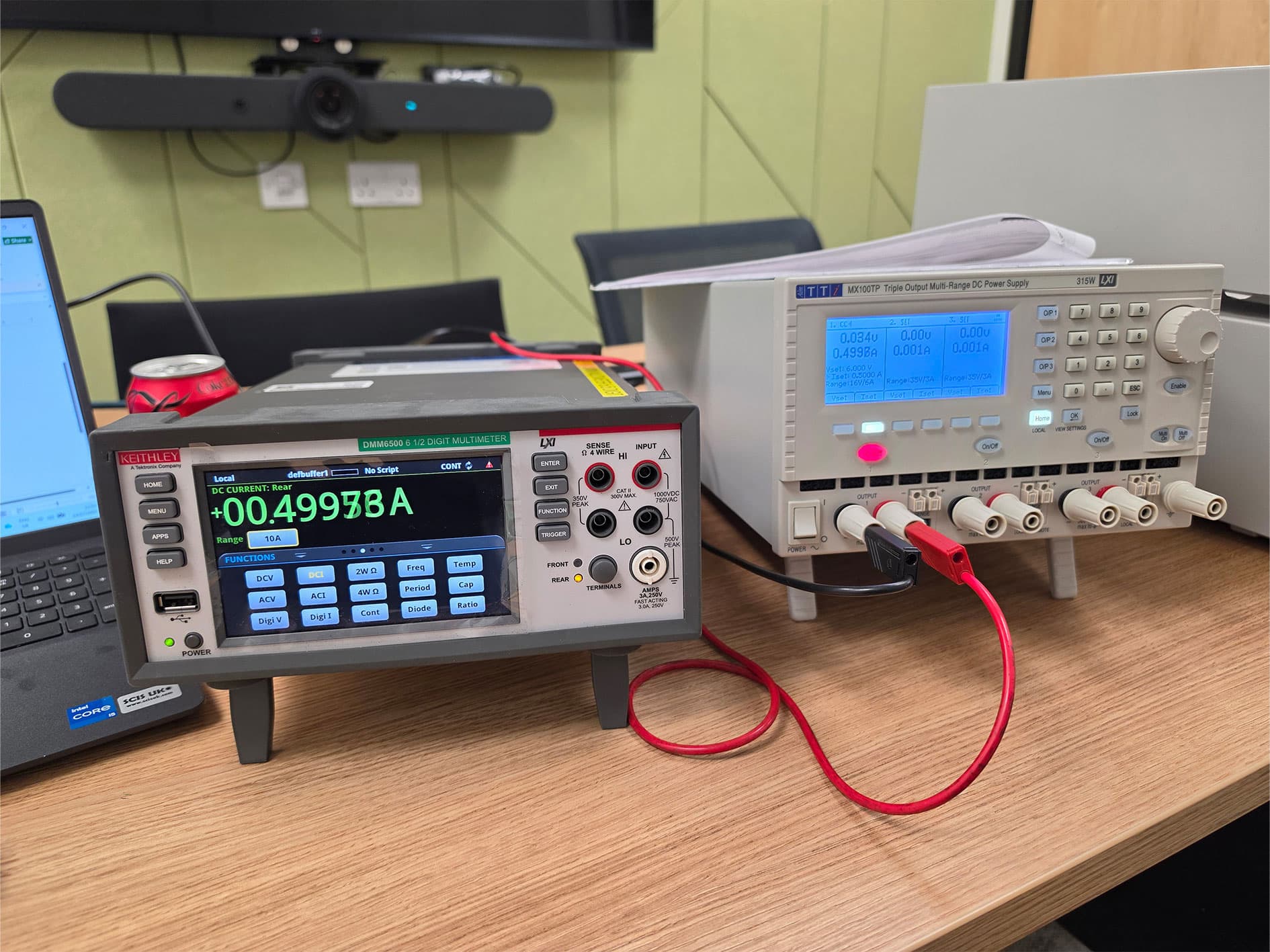
- Connect Reference Meters: Attach a calibrated, high-precision digital multimeter (DMM) to the output terminals to measure voltage and current accurately with suitable insulated test leads.
- Power On and Warm Up: Turn on the power supply and allow it to reach its normal operating temperature (usually 15 to 30 minutes).
- Calibration: Calibrate points within each channel designation i.e. Ch1 60V/10A, 16V/1A, 5V/0.5A. Use the same method for each channel e.g. CH1, CH2 & CH3.Test the voltage and current outputs at multiple points (low, medium, and high range) to ensure linearity and accuracy (I tend to do between 3, 4 and 5 test points depending on range). E.g. doing 4 or even 5 points on 1A is overkill.
Here to help.
If you have any questions about any of our instruments or services or have any technical enquiries, please fill out the contact form and we will be in touch as soon as we can.
Alternatively, contact us: