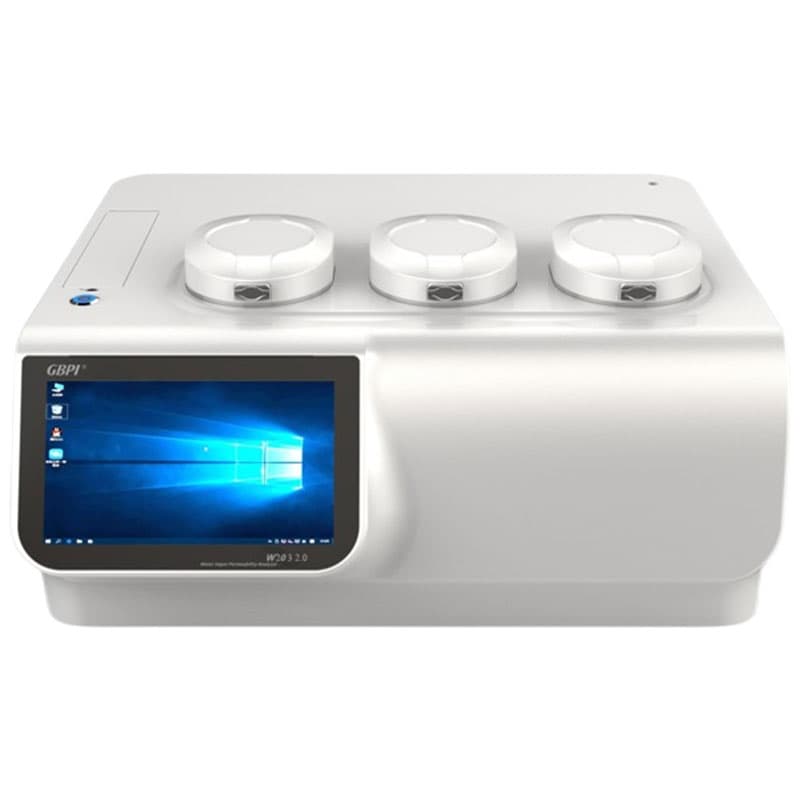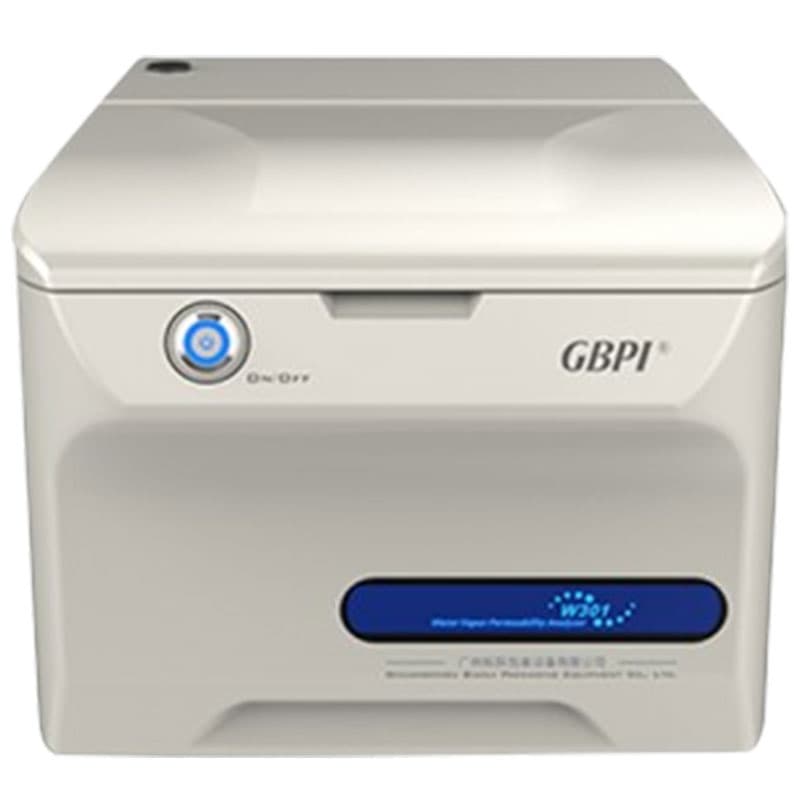
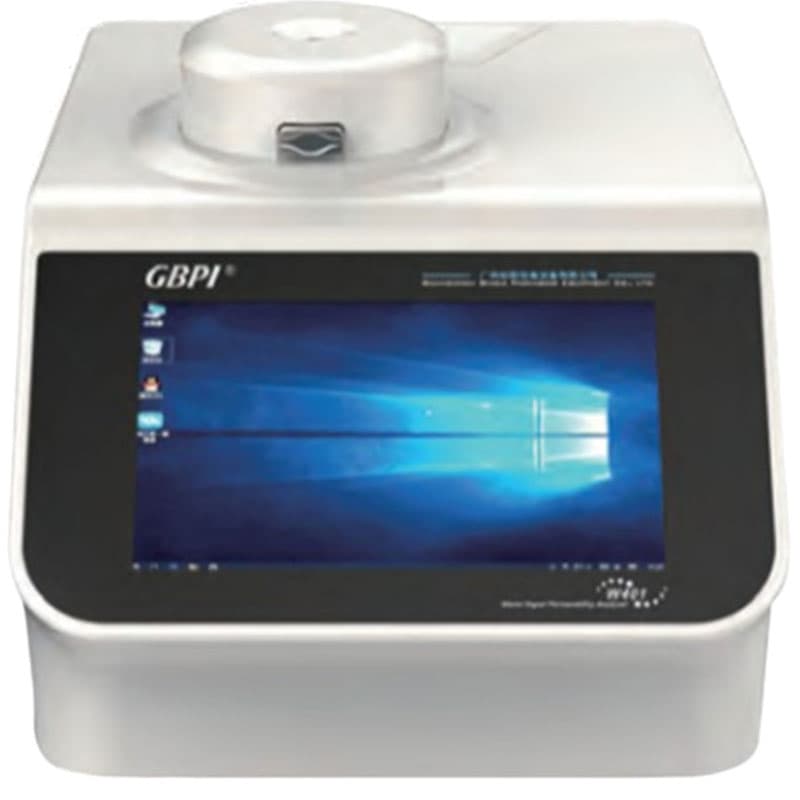
W401 2.0 Water Vapour Transmission Rate Tester
Manufactured by GBPI Testing Instruments
The W401 2.0 Water Vapour Transmission Rate (WVTR) Tester is an ideal configuration instrument for offline or online testing of the barrier properties of packaging materials for production units in the packaging industry.
It adopts the testing principle of infrared method to meet the needs of high-throughput, wide range, and high-applicability testing.
Price on quotation
Benefits
- High-precision, high sensitivity imported infrared sensor ensure ultra-high stability and ultra-low failure rate, with a resolution of 0.0001 g/(m2·24h).
- Designed and manufactured with reference to the standard of GB/T 26253.
- New pneumatic control system provides an automatic fixture, one-button lock of the sample, which is labour-efficient and convenient, as well as giving superior sealing performance.
- Semiconductor stabiliser automatically controls the temperature, with a temperature accuracy of 0.1°C.
- Dual airflow (dry and wet) humidity control ensures stably humidity, high precision, and humidity accurate to ±1%RH.
- Single test chamber, fast data test.
- 11.6-inch high-resolution colour LCD screen provides a clear view, sensitive control, and easy operation.
- Fully automatic operation, one-button test, judgement, and shutdown.
- Real-time display of five sets of curves: transmission-time, temperature-time, humidity-time, flow-time, and voltage-time.
- Curves support a preview hidden function.
- Intelligent operating system with modular graphics and flexible setting of test process parameters.
- Audit and tracking function, and multi-level permission settings for users can meet the requirements of the pharmaceutical industry for data traceability.
- Can be connected to the Internet of Things (IoT) platform to achieve digital network management, such as managing experimental data.
- Adopting state reference materials to calibrate and verify the instruments, ensure the accuracy, universality, and authority of the test data.
| Films | Water vapour transmittance rate test of film-like materials such as: Various plastic films (PP/PET/PE/PVC/BOPP/CPP, etc.), plastic composite films, paper-plastic composite films, metal composite films, co-extrusion films, aluminised films, degradable packaging films (PLA/PBAT/PBS) etc.), and other film-like materials. |
| Sheets | Water vapour transmission test of solid pharmaceutical hard sheet (PP/PVC/PTP, etc.), metal composite sheet, rubber sheet, and other sheet materials. |
| Paper, cardboard and their composites | Water vapour transmission test of coated paper, silicone paper, aluminised paper for cigarette packs, paper-aluminium-plastic composite sheet, and cardboard. |
| Medicinal patches | Water vapour transmission test of medical plasters. |
| Packages | Customised fixtures can be extended to packaging parts, such as pharmaceutical polyethylene bottles, sealed bags, pharmaceutical ointment tubes, infusion hoses, plastic trays, etc |
Standards
ASTM F1249, BS EN ISO 15106-2, JIS K7129, GB/T 26253, YBB 00092003
“State Certificate for Gradation of the certified Reference Materials and Licence for Manufacturing Measuring Instruments of the state Reference Materials (GBW(E)130543/4) of Water Vapour Permeability analyser approved and issued by General Administration of Quality Supervision, Inspection, and Quarantine of the P.R.C.
Technical Data
Test range: 0.002~100 g/(m2·24h)
Repeatability: 0.005 or 2% Take the bigger
Test precision: 0.0001 g/(m2·24h)
Temperature range: 15~45°C
Temperature accuracy: ±0.1°C
Humidity range: (5 ~ 90) %RH, 100%RH
Humidity accuracy: ±1%RH
Test area: 50.24 cm2
Sample size: Φ100 mm
Sample thickness: ≤3 mm
Test sample number: 1 piece
Carrier gas: 99.999% N2 (user provide)
Carrier gas pressure: ≥0.1 MPa
Carrier gas flow: 5~100 mL/min
Pneumatic pressure: ≥0.3 MPa
Power: 450W
Power supply: AC 220V, 50Hz
Dimensions: 380mm x 620mm x 385mm