
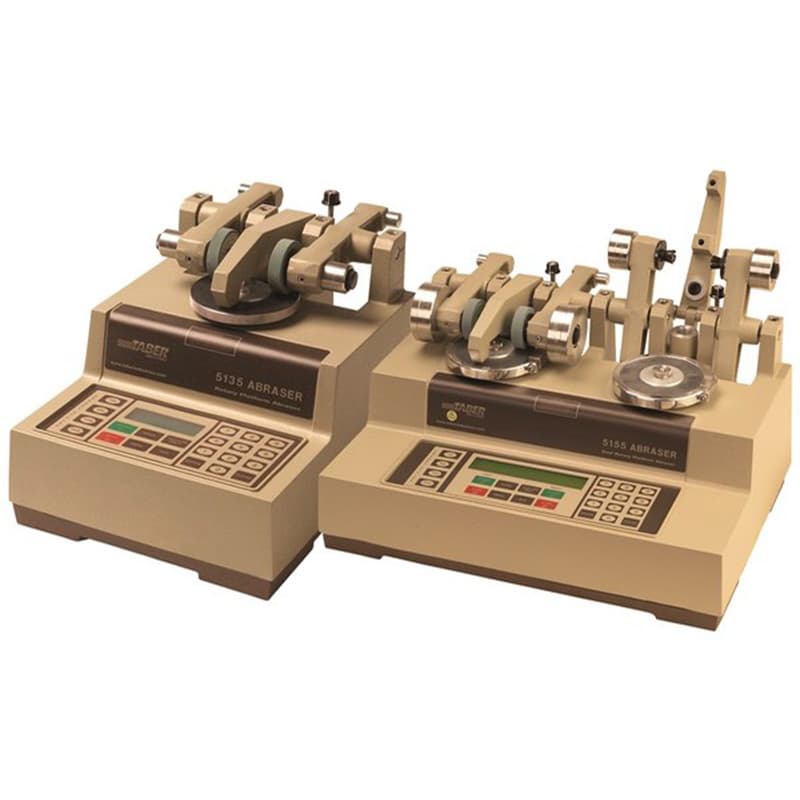
TABER Rotatory Platform Abraser
Manufactured by Neurtek
Cited in many standards as a the Rotary Platform Dual Head Tester, this precision-built instrument is used for evaluating the abrasion resistance of a wide range of materials, including textile fabrics, ceramics, metals, paper, stone, glass, and painted surfaces.
It can be used to test virtually any flat specimen, with the machine capable of providing reliable data in a matter of minutes, compared to the years that may be required with in-use testing.
Two models are available (single or dual specimen tables). Both offer the same durable design and can be used interchangeably.
Price on quotation
Benefits
- Assembled in a sturdy, sealed aluminium housing and operated by a control panel membrane.
- Wheels traverse a complete circle on the specimen surface, revealing abrasion resistance at all angles relative to the weave or grain of the material.
- A vacuum system is included with each abraser, and is critical for the proper operation of the instrument.
- The vacuum nozzle(s) is hinged to an adjustable mounting at the rear of the housing, allowing the height to be modified for accommodating varying specimen thickness.
- Precision stainless steel weights of 250 grams and 750 grams are furnished to provide standard wheel loads of 500 and 1000 grams.
- Incorporated into the rear of the abraser are two additional electrical receptacles.
- Conveniently marked, each receptacle has been designated for the vacuum system or an optional accessory instrument.
- Test parameters can be altered, which enables you to determine the optimal setting for each product or material.
- CE approved.
- Meets standards UNE 48250 and UNE EN ISO 5470-1.
- Choose from two models: Model 5135 features a single specimen table, while Model 5155 features a dual specimen table. This allows you to perform two tests simultaneously (test two different or identical specimens for comparison or contrast).
- Available as 115/230V; 60/50Hz switchable.
- Each turntable has dual abrading arms that are precision balanced.
- Independently operated, the abrading arms can be raised (or lowered) to mount or inspect specimens.
- Each arm is loaded for 250 gram pressure against the specimen with the wheel mounting assembly in place (exclusive of the weight of the wheel)
- To increase the load to 500 or 1000 grams, a mount for auxiliary weights is located on the outside of the abrading wheel bearing assembly. The location ensures that weights are concentric with the abrading wheel.
- A stud on the rear end of the abrading arm is used to carry an optional counterweight (used to reduce the wheel load 125 or 175 grams).
- The stud is also used to hold an abrading wheel as a counterweight to compensate for the weight of the working wheel.
Test a wide range of products
The Taber Abraser can be used to test virtually any flat specimen. Its field of application has included tests of: painted, lacquered, powder coated, and electroplated surfaces; textile fabrics ranging from sheer silks to heavy upholstery and carpeting; and solid materials such as metals, stone and ceramics. Other materials include paper, glass, plastics, leather, rubber, linoleum, laminates, plus many others.
How Does The Taber Abraser Work?
Up to ½” thick specimens, are mounted to a rotating turntable and subjected to the wearing action of two abrasive wheels, which are applied at a specific pressure.
Characteristic rub-wear action is produced by contact of the test sample, turning on a vertical axis, against the sliding rotation of two abrading wheels. The wheels are driven by the sample in opposite directions about a horizontal axis displaced tangentially from the axis of the sample. One abrading wheel rubs the specimen outward toward the periphery and the other, inward toward the centre. The resulting abrasion marks form a pattern of crossed arcs over an area approximately 30 square centimetres.
The TABER Abraser (Abrader) allows you to select:
* Load
- standard range includes 250g, 500g and 1000g
- optional counter weights increase range to 75g, 125g, 325g, 375g, 825g and 875g
* Abradants
- wide selection of Taber wheels available (resilient or vitrified)
- specialty wheels
- custom formulations
* Vacuum level
- programmable from keypad
- adjustable vacuum nozzle clearance
- range from 50% to 100%
* Test Duration
- programmable up to 50,000 cycles
* Conditions
- wet or dry
The TABER Rotary Abraser includes:
- Auxiliary Weights 500g load & 1000g load.
- Specimen Holder (E100-125).
- Hold Down Ring (E-100-101).
- Refacing Discs (S-11)/.
- Specimen Mounting Card Sample Package (S-36).
- Calibrase® Abrading Wheel Set (CS-10).
- Calibrade® Abrading Wheel Set (H-18).
- Vacuum Unit with Suction Hose & Round Brush.
Optional Accessories (sold separately):
- Calibration / Verification Kit.
- Sample Cutter.
- Wheel Refacer.
- Quiet Cabinet.
- Grit Feeder.
- Scuffing Head Attachment.
- Multi-Media Attachment.
- Interchangeable Specimen Tables.
- S-21 Extension Nut (specimen thickness ¼” to ½”).
- Arm Height Extension Kit (specimen thickness up to 40mm).
- Selection of Abrading Wheel Sets.
- Test Accessories.
- Haze Kit.