
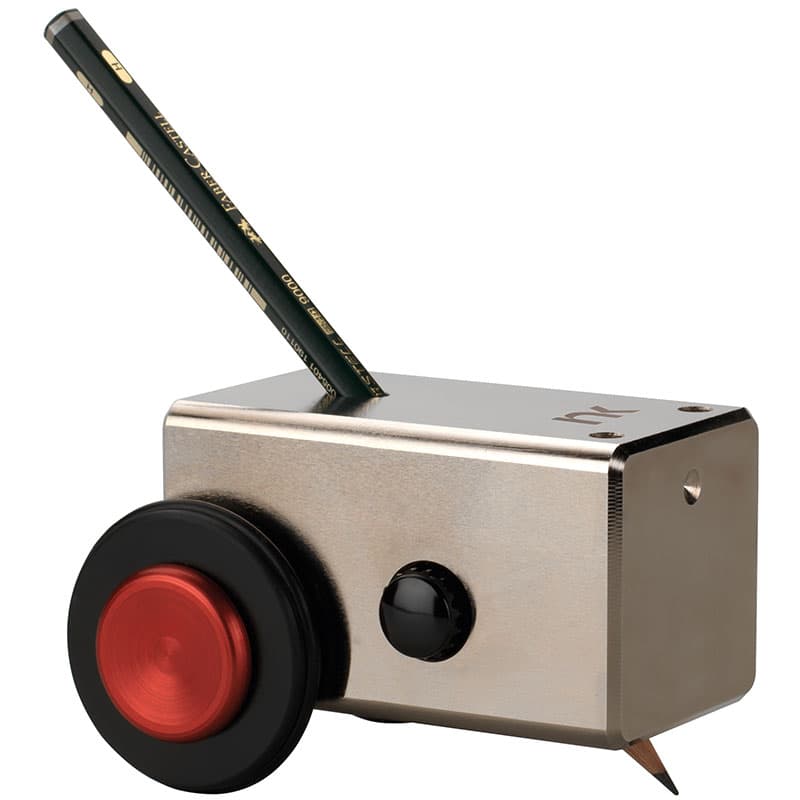
PH1100 Pencil Hardness Tester
Manufactured by Neurtek
This Wolff-Wilborn Pencil Hardness Tester reliably measures the surface hardness of coatings and paints using pencils of different hardness levels under controlled angle and pressure.
It uses a simple yet precise technique (based on the Wolff-Wilborn method), which provides repeatable results thanks to the constant angle and pressure. Operator errors are also minimised because of the pencil holder (included) that ensures constant hardness test parameters.
Important: If you need to verify the complete curing of paints or coatings, the Persoz or König pendulum is more suitable.
Benefits
- Reliable, simple, and effective technique to evaluate the hardness of many coatings.
- Versatility for different types of coatings and industrial sectors — automotive, furniture, etc.
- Allows quick pencil changes, reducing downtime.
- Repeatability is assured by the pencil holder.
- Resource optimisation — fewer stops and errors reduce material waste.
- Complies with the most demanding international standards, including UNE EN ISO 15184 and ASTM D 3363.
- Basic equipment includes 14 pencils (6B to 6H). Optionally harder pencils (7H, 8H and 9H) can be added for more demanding tests.
How does the Wolff-Wilborn test work?
- Pencils of known hardness are moved across the coating surface under a fixed load of 750g and at a 45° angle.
- The hardness of the film is determined by the pencil that damages the coating.
To perform the test, please see the following step-by-step instructions:
- Prepare and properly clean the surface.
- Select the pencil according to the hardness scale.
- Sharpen the pencil before the test.
- Place the pencil holder on the sample.
- Adjust the pencil in the corresponding hole until it touches the surface and tighten the side locking screw.
- Slide the device 6 to 12 mm over the surface, holding the scratch tester machine by the centre of the wheels.
Industries & Applications
- Automotive.
- Furniture.
- Quality control labs.
- Synthetic resins.
- Varnishes and industrial paints.
Standards
UNE EN ISO 15184, UNE 48269, ASTM D 3363, and DIN 13523-4.
What’s Included?
The standard kit includes:
- PH1100 pencil durometer.
- 14 pencils with hardness grades: 6B, 5B, 4B, 3B, 2B, B, F, HB, H, 2H, 3H, 4H, 5H, 6H.
- Test pencil holder.
- Pencil sharpener.
- Transport case.
- Optional: additional set with 7H, 8H and 9H pencils.