
What Are The Different Types Of Weighing Balance?
Weighing balances are essential measuring instruments used to determine the mass of an object. This guide will not only highlight how differ from weighing scales, but also identify the different types of laboratory balances, their common uses, and the things you can do to keep them in tip-top condition.
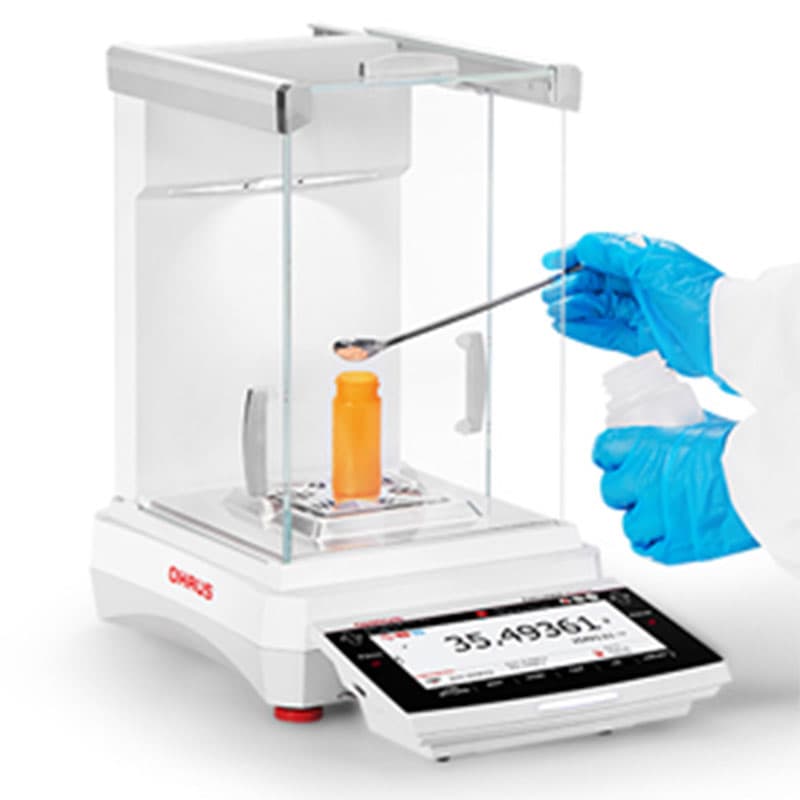
What is a weighing balance?
Also known simply as a ‘balance’, a weighing balance is a laboratory instrument used to measure the mass (the quantity of matter) of an object with a high degree of accuracy.
Balances are commonly used to measure small to medium samples where accuracy and repeatability are critical.
What’s the difference between a weighing scale and a balance?
While both scales and balances are devices used to weigh, there are clear differences in their typical application uses and capacity, precision, and sophistication.
Weighing scales
Scales measure weight (the measurement of the gravitational force on an object). They use robust load cell technology to convert this force into an electrical signal.
They’re suitable for general weighing tasks where ultra-high precision isn’t critical, such as weighing ingredients and stocktaking. Scales are typically built from very solid materials, as they’re designed for long, continuous use in high, throughput environments like busy parcel sorting warehouses and food production and processing facilities.
Scales are designed for higher capacities (from a few kilograms to several tonnes), with machines like bench, floor, and platform scales all suitable for handling heavy and large items.
Weighing balances
Balances typically operate with much finer resolution than scales and measure mass in small increments for higher precision measurements. For example, a 300-gram capacity balance would likely measure weight in 0.003-gram increments.
They’re ideal for controlled lab environments and used for tasks like pharmaceutical dosing and advanced scientific research.
Traditional equal-arm balances used to work by comparing between the object being weighed and a known pre-set standard mass.
However, most modern laboratory balances use electromagnetic force restoration (EMFR) or similar technology to determine the force to neutralise the sample. The force is then converted into a mass reading.
Because of their sensitivity and much finer readability (e.g. 0.01 g, 0.001 g, or smaller), balances require controlled conditions and careful handling to achieve exact results.
Their accuracy can be easily swayed by environmental conditions like air-flow, electrostatic charges, humidity, and temperature. However, internal calibration and adjustment functions like draft shields allow them to maintain highly consistent and reliable results.
There are many types of balances (see below), all with significantly lower capacities than scales (typically grams to a few kilograms) and often featuring an automatic internal calibration system. This performs routine maintenance by calibrating the balance daily, further ensuring accuracy and reproducibility.
Important: Even if your weighing balance is fitted with an internal calibration system, it’s vital you still book it in for a professional, external calibration (typically every 6 to 12 months) to maintain its accuracy and reliability.
Different types of weighing balances
Analytical balances
Analytical balances provide very high precision, typically 0.1 mg (0.0001 g) readability or better.
Most models like the Ohaus Explorer Plus™ Analytical EXR Analytical Balance are designed with draft shields. This creates a stable environment around the weighing pan by shielding it from external factors like air currents and dust which can affect the precision.
Common analytical weighing balance uses
- Checkweighing to ensure the weight of products and packages meet specified requirements.
- Chemical analysis.
- Precise sample preparation.
- Pharmaceutical formulation and recipe calculations.
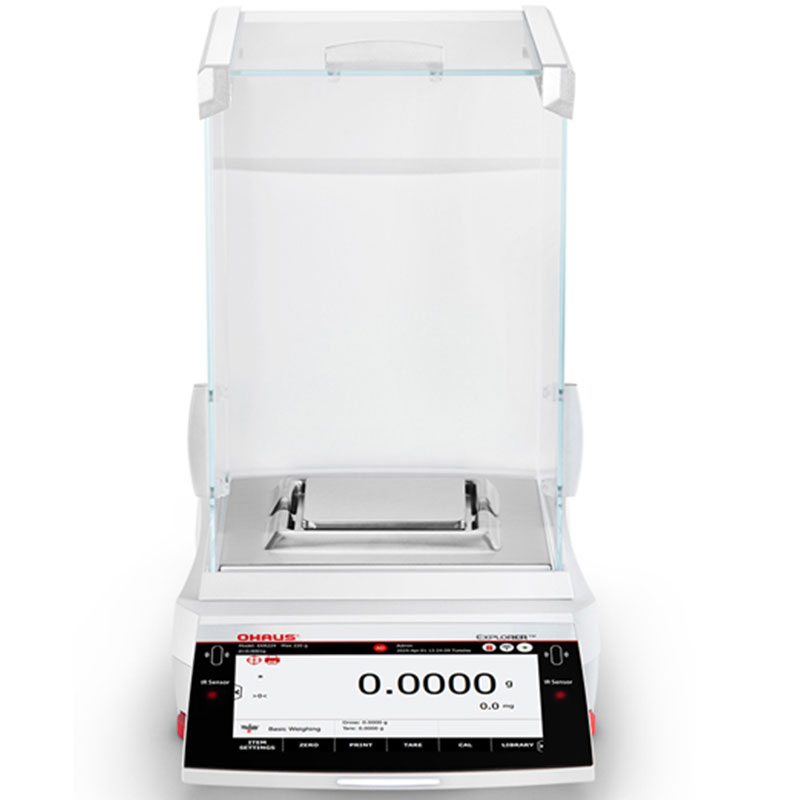
Front view of the OHAUS Explorer analytical balance with the draft shield closed and an empty weighing pan inside.
Precision balances
Precision (top-loading) balances offer a happy medium between accuracy, affordability, and capacity, with typical readabilities of 0.1 g to 0.001 g.
Some models like the OHAUS Explorer Plus™ Precision EXP Precision Weighing Balance are built with features like auto-tare functionality and multiple weighing applications for added convenience.
Common precision weighing balance uses
- Educational environments.
- General industrial weighing.
- Routine laboratory work.
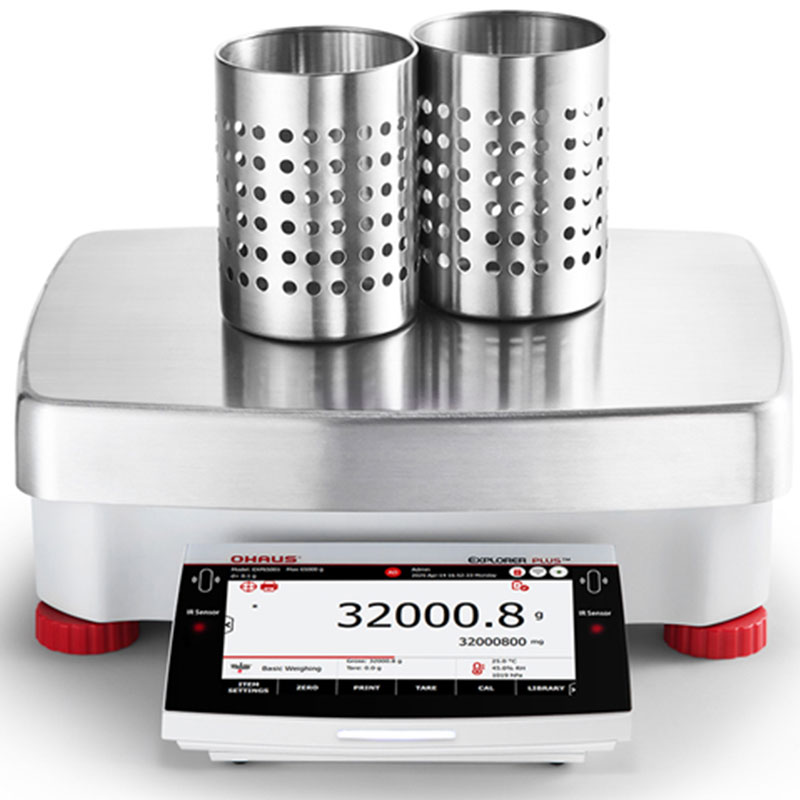
OHAUS Explorer Plus High Capacity EXP Precision Balance weighing two metal containers, screen showing 32,000.8 grams.
Semi-micro balances
Semi-micro balances offer enhanced resolution, typically 0.01 mg (0.00001 g), with dual-range capability on some models. The benefit of being “dual range” means they can weigh in tinier increments at the lower end of their capacity, and then in larger increments with the more you weigh.
They are ideal for:
- Differential weighing.
- Filter weighing.
- High-accuracy laboratory applications.
- Materials research.
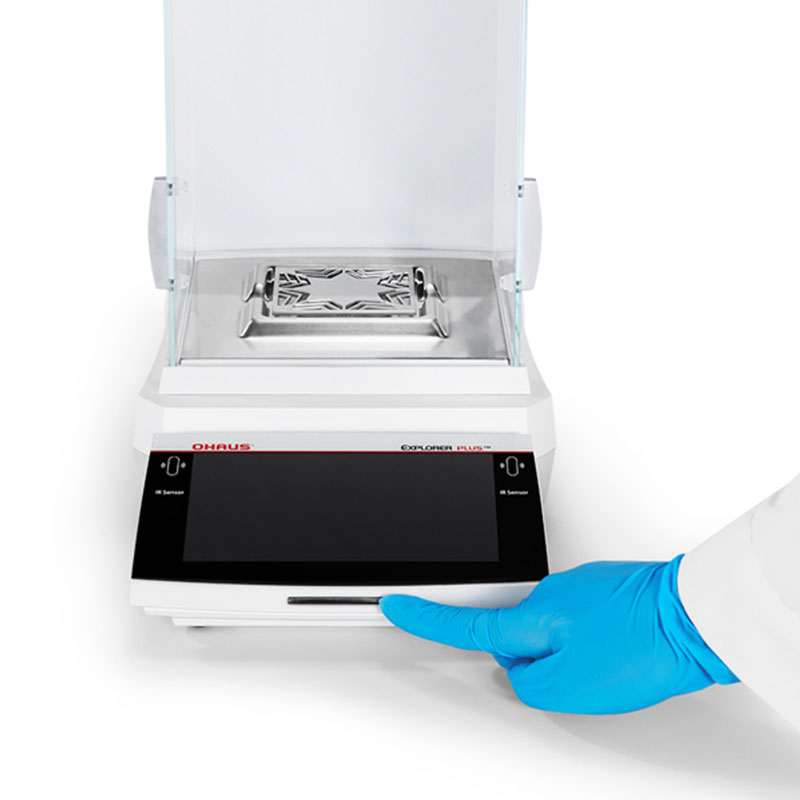
Laboratory professional using gloved finger to operate touchscreen of OHAUS Plus Semi-Micro EXP Balance.
Microbalances
Microbalances are used for exceptionally precise measurements of extremely small samples, with readabilities down to sub-microgram levels. They’re indispensable for extreme accuracy applications in the chemical, pharmaceutical, and scientific research industries, where small levels in weight variation can make a huge difference.
Common uses for microbalances
- Advanced research.
- Material science.
- Pharmaceutical and chemical analysis.
Key components of a weighing balance
While there are some subtle differences between the different types of balances (for instance, draft shields), most modern weighing balances are generally made up of the following components:
- Weighing pan – The surface where the object is placed to measure its mass. It’s usually made from stainless steel because of its durability and corrosion-resistance qualities.
- Load detection system (EMFR) – Detects the load and converts the force of weight into a measurable electrical signal.
- Display unit – The screen that shows the measurement result.
- Control interface – The operational brain of the balance (typically touchscreen), enabling you to control the device, run application modes, and execute specific tasks.
- Levelling feet and bubble level – This allows you to level the balance and ensure it’s perfectly horizontal. Some advanced weighing balances now come with motorised levelling, which automatically levels the balance for you.
- Data interface (USB/RS-232) – Enables connection to printers or software, so you can to send, receive, and exchange weight data
- Draft shield (on high-precision models) – Protects against air movement.
How to use a weighing balance correctly
For reliable results, the following steps need to be taken:
- Give the weighing pan a good clean, so it’s free from any debris, dirt, or dust.
- Place the balance on a stable, vibration-free surface, away from extreme temperatures, vibrations, and humidity.
- Turn on the balance and allow it sufficient time to warm up (Check the manufacturer’s handbook for guidance).
- Level the balance by adjusting the levelling feet and using the bubble indicator for guidance.
- Perform an internal calibration, either manually or using the automatic internal calibration function (if it has one).
- Tare the balance to set the readout to zero before adding the sample.
- Position the sample gently on the centre of the weighing pan (if your weighing chamber has doors, you’ll need to open them and then close them once you’ve placed the sample).
- Wait for the balance to stabilise (typically 2-3 seconds) before recording the reading.
Top tips when using weighing balances
As weighing balances are extremely sensitive instruments, you need to be careful when handling them, as well as carry out regular maintenance. Check out these six super tips to ensure long-term accuracy of your weighing balances:
- Avoid drafts, vibration, and temperature fluctuations.
- Always be delicate when placing the object on the weighing pan to avoid any impact damage to the balance’s mechanical or electronic components.
- Do not exceed the balance’s maximum capacity, as this can cause irreparable damage to the internal load cell and other sensitive parts.
- Handle samples with gloves or tools where appropriate. This prevents skin acids from contaminating the device and skewing the results.
- Use mild detergents and a soft cloth to keep the weighing area clean.
- Schedule regular external calibration (typically every 6–12 months for compliance and traceability).
How AML can help you choose the right balance device for weighing
All our laboratory balances are engineered to provide accurate and reliable measurements, as well meet the highest standards of reliability, speed, safety, and compliance with ISO 17025 requirements.
With extensive experience in weighing balance calibration, repair, and supply, we work with leading brands like Ohaus to provide you with premium weighing performance and consistent, traceable results.
Contact the AML Instruments team today to find the perfect balance that meets your application and accuracy demands.