
How To Calibrate A Torque Wrench
Finding a reliable torque wrench calibration service can be tricky. Without it, you can’t be confident your torque tool is delivering precise tightening or loosening of bolts, nuts, and other fasteners.
Let’s look at how torque wrenches are calibrated and how regular maintenance can help you uphold quality control standards, safety, and compliance with the latest ISO standard for torque calibration — ISO 6789-1:2017.
Does a torque wrench need calibration?
In a nutshell, yes! Like all test instruments, torque wrenches are only safe when used correctly and regularly calibrated. Torque wrench calibration should be a critical part of your quality management strategy and not treated like a box-ticking exercise, especially for industries like aerospace who can’t afford any lapses in safety and accuracy.
However, routine calibration of your torque instruments is a worthwhile investment for many reasons, not just meeting compliance and safety standards. Even if your top priority is product reliability and safety, torque wrench calibration maintains tool precision, eliminates guesswork, prevents component damage, and extends its lifespan, reducing the requirement for replacements and repairs.
Do click-type torque wrenches need to be calibrated?
Also known as ratcheting torque wrenches, mechanical click-type torque wrenches are known for their distinct ‘click’ sound when they reach the torque set value. This signals to the user there is no need to continue to apply force.
They rely on a pre-set internal spring mechanism, which will weaken and fatigue over time, especially if left tensioned, meaning they usually need calibrating more often than digital torque wrenches.
Do digital torque wrenches need to be calibrated?
Digital torque wrenches use electronic sensors that provide greater accuracy than mechanical ones. However, this doesn’t mean they’re immune to drift over time due to wear and tear, mishandling, and environmental factors like moisture exposure.
These digital torque tools cannot self-calibrate, and require the help of an external tool and trained engineer to undertake the correct procedure, so your digital torque wrench performs at its best.
How often should you calibrate a torque wrench?
Most brands will recommend you calibrate your torque wrench yearly or after 5000 cycles (whichever comes first). There are situations when this time or number of cycles should be reduced, i.e.
- After a wrench has been overloaded, dropped, or used to undo a nut.
- If the torque wrench has been overloaded by 25% or more.
- Post-repair. If internal parts have been handled or replaced, you must get your torque wrench recalibrated.
- Previous calibration results. Before your usual calibration frequency, you should get your torque wrench checked to see if it is close to the maximum allowed errors.
- The closeness to the maximum capacity the torque wrench is used. For instance if a 300 Nm is always used at 250 Nm or above, it should be more often than if it was always used at 30 Nm.
- Where the device is used or stored in poor conditions e.g., wet, or dusty.
- Where the torque wrench is used for a partially critical industry such as aerospace or motorsport.
What happens if your torque wrench isn’t calibrated?
The purpose of a torque wrench is to tighten bolts, nuts, or screws to a precise torque.
Applying a consistent and accurate torque to a bolt, nut, or screw is critical for it to securely hold whatever is in place. It’s important a bolt is not overtightened as it could break or shear. There have been many cases of catastrophic component failures, such as car wheel nuts being over tightened and wheels falling off at high speed!
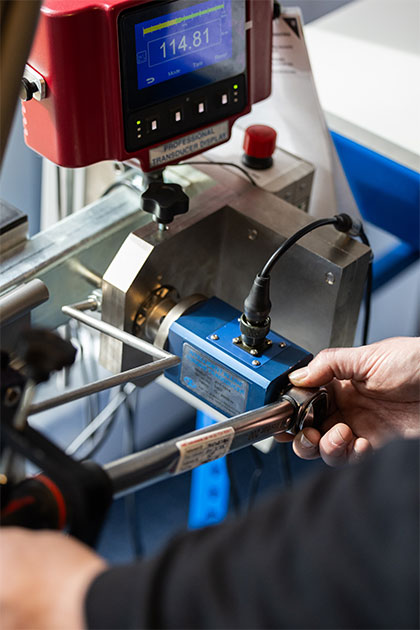
Close-up of hands operating a torque testing machine with a blue in-line torque transducer and a red digital display showing a torque value of 114.81.
Can you calibrate your own torque wrench?
Just like heart surgeons and underwater search and rescue teams, calibrating a torque wrench relies on specialised equipment and expertise like a torque transducer and calibration beams/fixtures. While cutting corners and saving money may seem tempting, it’s not recommended for both safety and mechanical precision reasons.
A thorough torque wrench calibration follows detailed steps, right from the initial preparation of cleaning and resetting the device to zero, to testing its accuracy at several points across the range. We’ve offered some general guidance below, but to be on the safe side, it is recommended you send your torque tools to a calibration technician or get them to come to you. This will give you the peace of mind your torque wrenches have been calibrated correctly, as the process will be correctly documented, and he/she will be far more efficient at calibrating.
- Exercise the torque wrench across its full range to ensure there are no restrictions to the mechanism and it reaches the whole range. It also gets the mechanism moving, resulting in better readings when done fully.
- Select the correct torque wrench adaptor / tester for the size of the wrench. There is no point doing a 10Nm wrench on a 500Nm tester as you will lose fidelity on the display if you are working to higher values (ensure the test equipment used is within calibration).
- Fit any required adaptor to the torque wrench to make it fit the adaptor properly. Do not use incorrect adaptors or unrated ones as they can introduce errors to the results.
- Select three fixed points along the range (you can do more). These are usually at the bottom, mid-range, and top of the scale.
- Test each of these points at least three times and record the results. Standard tolerances for your individual items can be found in the data sheet of your item, or apply a constant offset which you are comfortable with for the type of work you are carrying out. This should be discussed within your company and can be requested by a customer when booking in with us if a non-standard requirement is needed.
- Apply a pass or a fail to each torque wrench, and keep the information in a safe location either physically or electronically. Keeping these records over a prolonged time can help identify trends in wear and tear of assets, which in-turn helps you spot issues before they cause damage to another of your assets or a piece of equipment from a customer.
- Some torque wrenches that fail can be adjusted. Consult the information provided by the manufacturer to see if it can be and how to carry these out. Bear in mind, most adjustments on torque wrenches will affect the whole range, so when you are happy you have the range which was failing back within your tolerances, the torque wrench is still fit for purpose at the other ranges.
What if my torque wrench fails calibration?
Wherever possible, your torque wrench will be adjusted to bring it back within the requirements of ISO 6789:2017 — the method for the calibration of hand torque tools.
We will always record “As Found” results and “As Left” results if adjustment was necessary.
How to check if your torque wrench is calibrated
There are numerous tell-tale signs indicating whether or not your torque wrench is calibrated properly. Look for the following:
- Your torque wrench is delivering inconsistent or erratic readings.
- Your torque wrench is not clicking or signalling when it’s reached the desired torque level.
- Your torque wrench is not holding the desired torque level.
- Your torque wrench is bearing excessive wear and tear or damage. You should also get your torque wrench calibrated if it’s been dropped or mishandled.
If you notice any of these anomalies, it is recommended you have your torque wrench calibrated as soon as possible to ensure its accuracy, reliability, and safety.
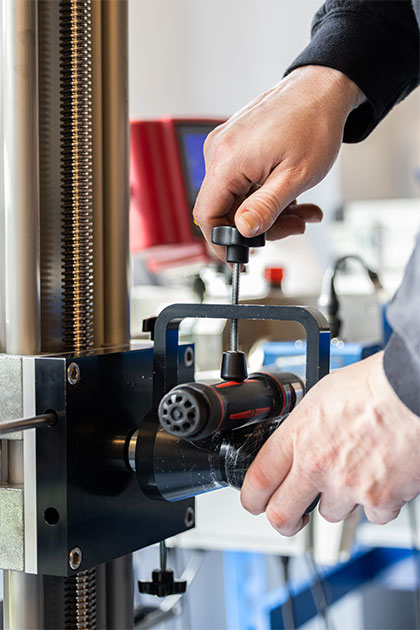
Close-up of hands adjusting a torque wrench on a piece of torque testing equipment with a vertical metal rail and electronic instruments in the background.
Where can I get my torque wrench calibrated?
Can’t be without your torque wrench or torque screwdriver? At AML Instruments, we make the entire process efficient and hassle-free.
Unless requested, our torque wrench calibration service is based on the requirements of the latest ISO standard for torque calibration ISO 6789-1:2017. You’ll also be issued with a calibration certificate to prove proper testing has been carried out to either national (traceable) or UKAS standards.
Did you know we’re both UKAS ISO 17025 and ISO 9001 accredited for temperature calibrations and weigh scales and balances calibrations (none automated weighing equipment)?
All enquiries are responded to within two hours — why not put us to the test today?
This post is not intended to replace the guidance listed in any of the national or international standards. It has been written to give an overview of the different care, procedures, and precision that go into the professional calibration of a torque wrench. The standards and guides listed in this post should be consulted and understood in detail before attempting your own calibration. If your industry requires documented, traceable proof of accuracy, or your torque wrench must be accurate within very tight tolerances, it’s essential you use a professional calibration provider.